
From Ankara to customer-focused improvement
Dr. Tony Tanaydin's journey through teaching, data analytics, business, and community service.
September 26, 2026 · Career reflections from DrT
Teaching is the thread that runs through Tony Tanaydin's career. Whether helping a student understand variation, working with an engineer on a reliability problem, or advising a business owner, his purpose has remained consistent: help people understand the situation in front of them and make better decisions.
Beginning in Ankara
Tony began his teaching career at Ankara University in Turkey while pursuing graduate studies. He taught calculus, problem solving, programming, and database applications. His work also involved coordinating courses, mentoring colleagues, helping develop the data analytics department, and managing university stores. Those responsibilities gave him early experience connecting analytical work with the practical demands of running an organization.
He earned his bachelor's degree in applied mathematics in 1985 and his master's degree in mathematical data analytics in 1988. His master's research examined stochastic dependence and correlation coefficients.
Data Analytics with practical applications at Purdue
Tony moved to the United States to pursue doctoral work in data analytics at Purdue University. Alongside his studies, he taught data analytics and probability with computer applications and worked with faculty and graduate students on study design, data analysis, and interpretation.
His consulting work crossed disciplines, including agriculture, animal science, veterinary medicine, and manufacturing. He helped researchers use analytical software while building their understanding of the methods behind the results. He completed an MS in applied data analytics in 1994 and a PhD in 1996, studying multivariate quality problems with Professor George McCabe.
Hewlett-Packard: connecting the customer to the factory
After graduation, Tony joined Hewlett-Packard in Oregon to put his analytical training to work in industry. He consulted with research, development, manufacturing, marketing, and customer support teams, taught analytical methods, and helped introduce Six Sigma as it gained momentum in industry.
His responsibilities grew to include business strategy, business planning, quality and reliability, and technical quality tracking. A central lesson was that a periodic scorecard could show a result without showing how performance was changing or where action was needed.
He developed HP's Quality Tracking Information Program, an online dashboard system with drill-down views and control charts. The system included more than 30,000 real-time field-performance graphs. The system connected warranty and call-center information, customer complaints, product returns, and factory issues, giving managers and technical teams a common basis for investigating emerging problems.
This work also involved improving the quality, timeliness, and usefulness of the data itself. Tony established processes for returned-product analysis, helped refine failure categories, and worked across functions so that customer experience could guide decisions in engineering and manufacturing. He also taught at Oregon State University while working in industry.
During his time at HP, Tony met Dr. Douglas (Doug) Mader, founder of SigmaPro. That professional connection became an important part of his later career. Mader's work links SigmaPro to the Six Sigma Academy, where he served as a vice president leading Design for Six Sigma, and to the early Six Sigma community associated with Mikel Harry and other pioneers of the methodology.
SAS Institute and the move into independent consulting
At SAS Institute, Tony helped establish a Six Sigma program and taught data analytics using JMP. He also contributed ideas for improvements to JMP while working with senior leadership. The connection between teaching, software, and practical problem solving continued to shape his approach.
He founded LodeStar Institute to bring that approach to a wider range of organizations. During this period, his association with Doug Mader continued through work with SigmaPro as a Master Black Belt. Consulting, training, and mentoring assignments have spanned technology, manufacturing, lumber, construction, banking, finance, healthcare, medical devices, government, and service organizations.
His work has included Lean Six Sigma deployment, Design for Six Sigma, voice-of-the-customer analysis, reliability, process measurement, and the development of Black Belt and Green Belt programs.
What improvement looks like in practice
Tony's background includes projects that show the range of questions this work can address:
- Banking: improve the speed, quality, and reporting of online project delivery.
- Finance operations: shorten a month-end closing process that had required extensive overtime.
- Customer service: investigate supply-chain and call-center defects that generate avoidable service requests.
- Sales: identify controllable causes of missed opportunities and guide teams toward recovering them.
- Medical devices: apply Design for Six Sigma to product development, reliability, and redesign.
- Manufacturing: reduce downtime and improve production flow.
Across these settings, the work begins with the business need, the customer experience, and reliable evidence. The method follows the problem.
Public service, food manufacturing, and aerospace
Tony later accepted a principal data scientist and Master Black Belt position with the U.S. federal government in Missouri, followed by work as a Master Black Belt and principal data scientist at PepsiCo/Frito-Lay. At GKN Aerospace, his operational excellence responsibilities extended across eight North American sites, with a focus on business performance, bottom-line improvement, and staff development.
These settings brought different products, constraints, and stakeholders. Each required understanding the organization as a system and helping people translate findings into changes they could sustain.
From vision to execution, with today's tools
Tony's improvement framework connects customer service, product and service development, and Lean Six Sigma. Its intended outcomes are increased revenue, reduced cost, and greater customer satisfaction.
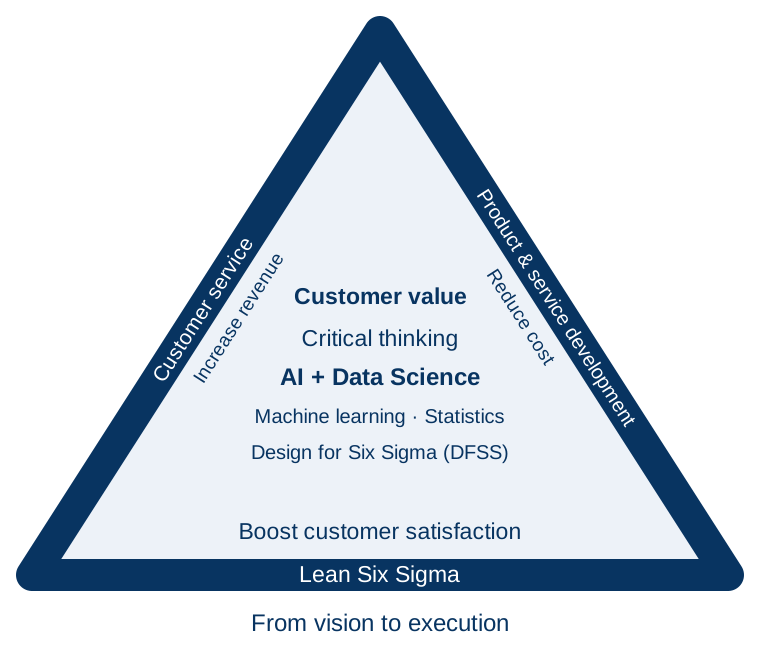
AI and data science have been integral to Tony's approach to Lean Six Sigma, process improvement, critical thinking, and teaching. As technology has advanced, these disciplines have become a more explicit focus in his courses and consulting, with new possibilities for exploration, modeling, programming, and interpreting complex information. Critical thinking still determines which question to ask, whether the data is trustworthy, and whether a proposed change helps the customer.
Mentoring through real projects
Mentorship is a commitment Tony brings to every engagement: at universities, within companies, and through LodeStar Institute. He walks clients and students through projects and practical applications of what he teaches, helping them frame questions, choose methods, interpret results, and put their learning into practice.
He has served on numerous PhD committees and supported graduate students across disciplines. That support includes helping students develop research papers, work through analytical questions, and complete special projects. For Tony, teaching continues beyond the classroom as people build the confidence and judgment to apply what they have learned.
A career of learning and professional service
Tony's teaching has continued alongside consulting and industry work. At Southern Methodist University, his teaching and mentoring have included machine learning, neural networks, deep learning, programming, and applied data analytics. He sees continued learning as part of the responsibility of advising others.
His professional activities have included service with the Baldrige National Quality Program, board and leadership roles with the American Society for Quality, involvement in the American Analytical Association, and leadership in a Purdue alumni chapter. He has presented at quality and data analytics conferences and reviewed technical papers and books.
His research and presentations have addressed multivariate robust design, quality control, customer-centered Six Sigma, voice-of-the-customer systems, measurement systems, and DMAIC. His professional background includes project-management training, ASQ Six Sigma Black Belt certification in 2002, and Master Black Belt certification in Lean Six Sigma / Operational Excellence and Design for Six Sigma in 2004.
Customer value and community in Plano
Tony now lives in Plano, Texas. His goals for LodeStar are increasingly community-oriented: working with people, supporting learning, helping nonprofit organizations, and contributing to improvements that matter in everyday life.
He places customer value at the foundation of business performance. This aligns with his understanding of lean thinking: companies create products and services to provide something people value, and improvement starts by understanding that value from the customer's perspective. In this hierarchy, serving customers well strengthens the business, supports its growth, and creates lasting shareholder value. A flourishing company follows from delivering value consistently. Teaching, consulting, and mentoring are ways Tony helps organizations put that principle into practice.
View DrT's professional profile · Start a conversation with LodeStar